Opening a business in Dubai? SIRA approval comes before your first customer
If you run a shop, hotel, warehouse, pharmacy, gold store, exchange house or almost any commercial premises in Dubai, your CCTV system is not optional and not up to you. It is regulated by SIRA — the Security Industry Regulatory Agency, established under Dubai Law No. 12 of 2016. Many trade licence activities cannot operate until the premises passes a SIRA-compliant security inspection.
Business owners usually discover this at the worst moment: during fit-out, days before opening, when the mall management or licensing authority asks for the SIRA certificate. This guide explains what SIRA expects, who needs it, and how to get compliant without losing weeks.
What is SIRA and why does it control your cameras?
SIRA regulates the entire private security industry in Dubai: guard companies, security consultants, system installers, and the technical standards for video surveillance in commercial buildings. Its Video Guidelines define how cameras must be selected, positioned, recorded and maintained.
Two rules matter most for a business owner:
- Only SIRA-approved companies and certified engineers may design and install your CCTV. A cheap installer without SIRA certification produces a system that fails inspection — you pay twice.
- The system itself must meet SIRA technical standards — camera coverage, image quality, recording retention, and in some categories connection to monitoring platforms.
Who must comply?
SIRA requirements apply across commercial Dubai. Categories with the strictest, most detailed requirements include:
- Hotels, hotel apartments and guest houses
- Gold, jewellery and precious metals shops
- Exchange houses and financial institutions
- Supermarkets, groceries and retail stores
- Pharmacies
- Petrol stations
- Warehouses and industrial units
- Restaurants and cafés
- Residential towers and shared buildings (owner associations)
- Nurseries, gyms, salons and other licensed activities
Each category has its own annex in the SIRA guidelines specifying where cameras are mandatory — entrances, exits, cash counters, safes, storage rooms, parking, lifts and lobbies — and what image quality each position must achieve.
The core technical requirements
Exact specifications depend on your business category, but the recurring SIRA themes are:
- Coverage. Every public entrance and exit, every cash handling point, and category-specific zones must be covered with no blind spots. Face-recognition quality is expected at entry points.
- Image quality. Minimum resolution and frame-rate standards per camera position. A blurry camera that technically records is still a failed camera.
- Retention. Recordings must be kept for at least 31 days — longer for some categories. Storage must be sized for continuous recording, not motion-only guesswork.
- Time synchronisation. Correct date and time stamps on all footage. Inspectors check this because unsynced footage is worthless as evidence.
- System health. Failed cameras and full hard disks are violations, not bad luck. Some categories require maintenance contracts with a SIRA-approved company.
- Signage and privacy. Cameras must not cover areas where privacy is protected (toilets, changing rooms, prayer rooms), and surveillance notices are required.
SIRA updates its guidelines periodically. Before buying anything, confirm the current requirements for your specific activity — or let your installer carry that responsibility contractually.
The compliance path, step by step
- 1. Site survey and risk assessment. A SIRA-certified engineer maps mandatory camera positions for your category and floor plan.
- 2. System design and approval. Camera schedule, storage calculation and layout drawings prepared to SIRA standard.
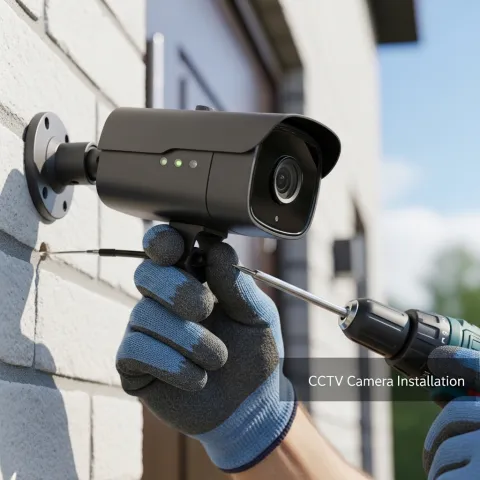
- 3. Installation by certified technicians. Cabling, cameras, recorder, and configuration to the approved design.
- 4. Testing and handover. Retention verified, time sync verified, image quality checked per position.
- 5. Inspection and certificate. The premises passes inspection; you receive the compliance certificate your licence or mall management asked for.
- 6. Ongoing maintenance. Periodic checks keep the system compliant — a dead camera discovered during an incident is the expensive kind.
Common mistakes that fail SIRA inspection
- Buying a residential camera kit for a commercial premises — wrong resolution, wrong retention capacity
- Installer without SIRA certification — the paperwork is rejected regardless of how good the cameras look
- Storage sized for 7 days when the rule says 31
- Cash counter camera positioned to see the till but not the transaction
- No coverage of the back door because "only staff use it"
- System installed, then never maintained — failed disk found at inspection
What does SIRA-compliant CCTV cost?
It depends on camera count and category. A small retail shop needs fewer positions than a hotel. As a rough orientation, small-shop compliant systems in Dubai typically start from a few thousand dirhams installed, scaling with size and category strictness. A precise number requires a floor plan and your activity type — which is why we survey before quoting, free.
How Secure Eye Technologies helps
We design and install SIRA-compliant CCTV for shops, restaurants, warehouses and commercial buildings across Dubai, and we handle the full path: survey, design, installation, testing, inspection support, and annual maintenance contracts that keep the certificate valid year after year. If you also operate in the Northern Emirates, we align the same system design with Ajman Police requirements and Sharjah Police standards, so one vendor covers all your branches. Start with our CCTV installation service.
Frequently asked questions
Do small shops in Dubai really need SIRA-compliant CCTV?
Yes. Retail is a covered category. Camera count is smaller than a hotel or exchange house, but coverage of entrances and the cash point, image quality and 31-day retention still apply.
How long must CCTV footage be stored in Dubai?
At least 31 days for most commercial categories, and longer for some higher-risk activities. Storage must support continuous recording for the full period.
Can I install cameras myself and then get them approved?
Not for a commercial premises. Design and installation must be done by a SIRA-approved company with certified engineers and technicians, or the system will not pass.
What happens if a camera stops working?
A non-functioning camera is a compliance violation and can lead to fines, especially if an incident occurs while it is down. A maintenance contract with scheduled health checks is the practical protection.
Does villa or home CCTV in Dubai need SIRA approval?
Private homes are treated differently from commercial premises — but privacy rules still apply, and quality standards are worth following voluntarily so footage is actually usable. Ask us what makes sense for your villa.
Get your premises compliant before the inspector visits
Send us your floor plan and trade licence activity, and we will tell you exactly which cameras SIRA expects, where, and what it costs installed.
Call or WhatsApp +971 58 589 8309, or email aslam@secureye.me — free SIRA compliance survey anywhere in Dubai.